Proposal
IELTS Self-Learning Web System
An Intelligent Platform for Independent IELTS Preparation
1. Executive Summary
The IELTS Self-Learning Web System is a comprehensive online platform designed to support students in their independent IELTS preparation journey. The platform provides an all-in-one solution featuring user management, educational blogs, interactive study rooms, practice tests, and AI-powered flashcard systems. Leveraging modern web technologies and AI integration, the system offers personalized learning experiences, real-time collaboration features, and automated assessment tools to help students achieve their IELTS goals efficiently.
2. Problem Statement
What’s the Problem?
Many IELTS learners face challenges in finding affordable, comprehensive, and interactive self-study platforms. Traditional learning methods lack real-time collaboration, personalized feedback, and integrated practice tools. Students often struggle with:
- Limited access to quality practice materials and mock tests
- Lack of immediate feedback on Speaking and Writing tasks
- Difficulty finding study partners and maintaining study discipline
- Fragmented resources across multiple platforms
- High costs of traditional IELTS preparation courses
The Solution
The IELTS Self-Learning Web System provides a unified platform with five core features:
User Management System: Multi-tier membership (Guest, Member, Premium, Admin) with social authentication (Google, Facebook), personal profiles, and messaging capabilities.
Educational Blog Platform: Community-driven content with CRUD operations, genre/tag categorization, advanced filtering, commenting, reporting, and favoriting features.
Interactive Study Rooms: Virtual study spaces with scheduling, voice/video calls, Pomodoro timers, background music, dictionary integration, and translation support for enhanced learning.
IELTS Practice Tests: Comprehensive mock tests for Reading and Listening with automatic vocabulary extraction into flashcards, plus AI-powered assessment for Speaking and Writing tasks, and dictation exercises.
Quizlet Flashcard System: Intelligent flashcard creation with multiple study modes, automatic vocabulary extraction from texts, AI-generated quizzes from uploaded materials, and sharing capabilities.
Benefits and Return on Investment
- For Students: Cost-effective alternative to expensive courses, personalized learning paths, 24/7 access to study materials, AI-powered feedback, and collaborative learning environment.
- Educational Value: Develops self-discipline, provides comprehensive IELTS preparation, enables peer learning, and offers trackable progress.
- Technical Benefits: Scalable architecture, modern tech stack, AI integration for automated assessment, and potential for future feature expansion.
- Market Potential: Growing demand for online IELTS preparation, subscription-based revenue model (Guest → Member → Premium), and potential for partnerships with educational institutions.
3. Solution Architecture
The platform employs a modern full-stack web architecture designed for scalability, real-time collaboration, and AI integration. The system consists of five major modules working together to provide a comprehensive IELTS learning experience. The infrastructure uses an active-passive Multi-AZ deployment on AWS ECS for high availability, where AZ-1 handles all active traffic and AZ-2 serves as a standby for automatic failover.
System Architecture Overview:
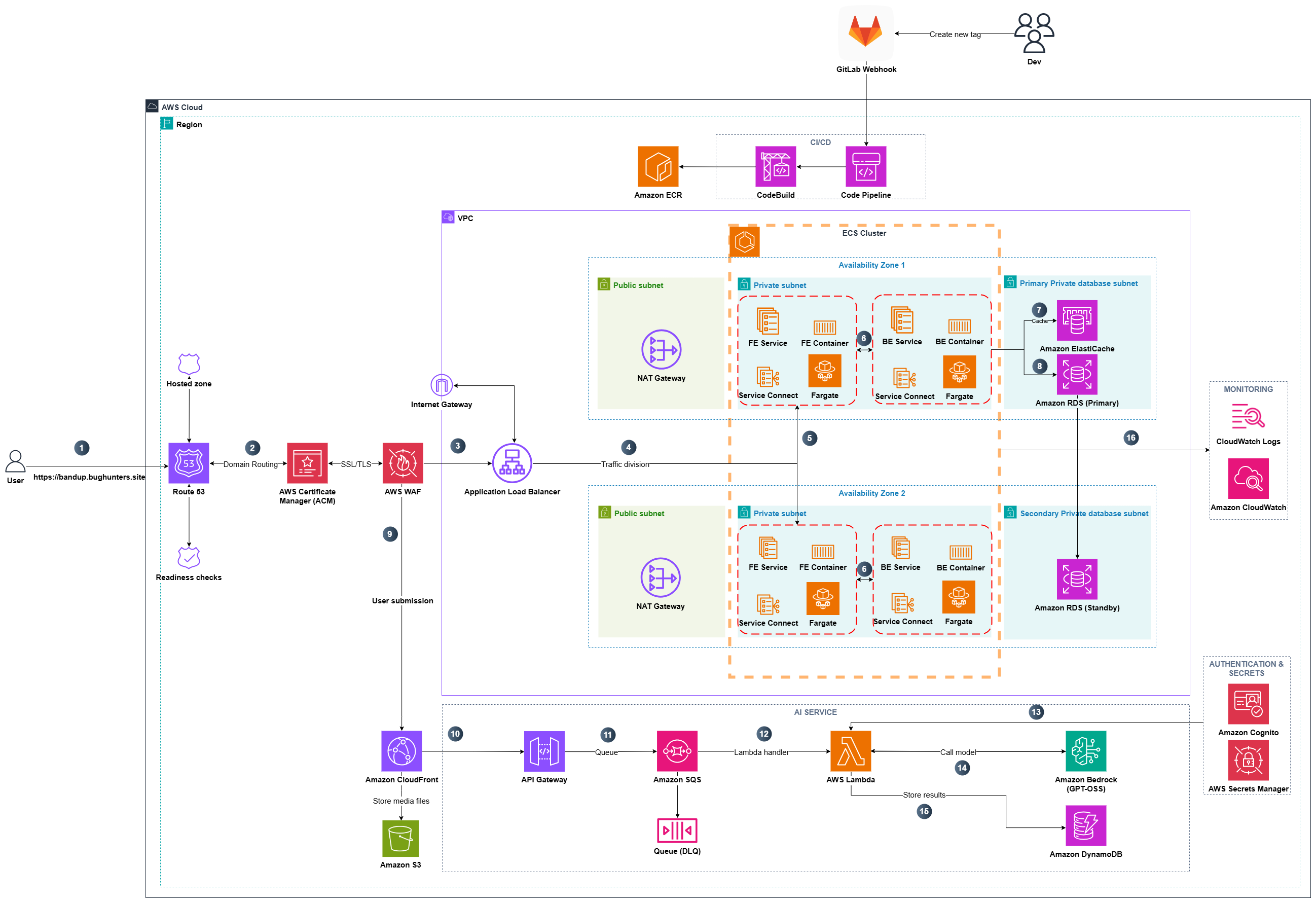
Technology Stack
Frontend:
- Next.js 14+: Modern React framework for responsive web application
- TypeScript: Type-safe development
- TailwindCSS: Utility-first styling
- WebRTC: Real-time video/voice communication
- Socket.io Client: Real-time messaging and collaboration
Backend:
- Spring Boot 3.x: Monolithic RESTful API architecture
- Java 17+: Backend programming language
- Spring Security: Authentication and authorization
- Spring WebSocket: Real-time communication
- JWT: Secure token-based authentication
- OAuth 2.0: Social login integration (Google, Facebook)
Database:
- PostgreSQL 14+: Primary relational database for all data (users, tests, blogs, flashcards, study sessions)
- Amazon ElastiCache (Redis): Caching and session management
Cloud Infrastructure (AWS):
- Amazon ECS (Elastic Container Service): Container orchestration with active-passive Multi-AZ deployment
- Application Load Balancer: Routes traffic to active AZ with automatic failover
- Amazon RDS for PostgreSQL: Multi-AZ deployment (active primary in AZ-1, passive standby in AZ-2)
- Amazon S3: Media and file storage
- Amazon CloudFront: CDN for static assets
- Amazon CloudWatch: Monitoring and logging
Third-party Services:
- Google Gemini Flash API (Free Tier): AI-powered Speaking/Writing assessment and content generation
- Free Dictionary APIs: Word definitions and examples
- Open-source translation libraries: Context-aware translation (alternative to paid APIs)
Component Design
1. User Management Module:
- Multi-tier authentication system (Guest, Member, Premium, Admin)
- Social OAuth integration (Google, Facebook)
- User profile management with learning statistics
- Real-time messaging system
- Password recovery and email verification
2. Blog Platform Module:
- CRUD operations for blog posts
- Genre and tag management system
- Advanced search and filtering (by tags, genres, date, popularity)
- Comment system with nested replies
- Content reporting and moderation
- Favorite/bookmark functionality
- SEO-optimized content delivery
3. Study Room Module:
- Virtual study room creation and management
- Study session scheduling with calendar integration
- WebRTC-based voice and video calls
- Pomodoro timer with customizable intervals
- Background music library with focus playlists
- Integrated dictionary with free dictionary APIs
- Translation support using open-source libraries
- Screen sharing for collaborative study
- Real-time participant management
4. IELTS Practice Test Module:
- Test bank management (Reading, Listening, Speaking, Writing)
- Timed test simulations with auto-submission
- Automatic vocabulary extraction from Reading passages to flashcards
- AI-powered Speaking assessment using Gemini Flash (pronunciation, fluency, coherence)
- AI-powered Writing assessment using Gemini Flash (grammar, vocabulary, task achievement)
- Dictation exercises for Listening practice
- Detailed score reports and analytics
- Progress tracking across test types
5. Quizlet Flashcard Module:
- CRUD operations for flashcard sets
- Multiple study modes (flashcards, learn, test, match, write)
- Spaced repetition algorithm (SRS)
- Automatic vocabulary extraction from text passages
- AI-generated quizzes from uploaded documents/texts using Gemini Flash
- Collaborative flashcard sets with sharing
- Study statistics and mastery tracking
- Import/export functionality
4. Technical Implementation
Implementation Phases
Phase 1: Planning and Design (Weeks 1-2)
- Requirements gathering and user story definition
- System architecture design and AWS infrastructure planning
- Database schema design for PostgreSQL
- UI/UX wireframes and mockups
- API endpoint design for Spring Boot
- Third-party service evaluation and integration planning
- Multi-AZ architecture setup on AWS ECS
Phase 2: Core Development (Weeks 3-6)
- Spring Boot application setup with monolithic architecture
- User authentication and authorization with Spring Security
- PostgreSQL database setup on Amazon RDS (Multi-AZ: active-passive)
- JWT and OAuth 2.0 integration (Google, Facebook)
- Next.js frontend setup with TypeScript
- Frontend component library creation
- Basic CRUD operations for all modules
- AWS ECS cluster configuration with active-passive failover
Phase 3: Feature Development (Weeks 7-10)
- Blog platform with advanced filtering and search
- Study room creation with WebRTC integration
- Practice test module with automatic grading logic
- Flashcard system with spaced repetition algorithm
- Real-time messaging with Spring WebSocket
- Dictionary and Google Translate API integration
- Amazon S3 integration for file uploads
- ElastiCache Redis for session management and caching
Phase 4: AI Integration & Deploying (Weeks 11-12)
- Google Gemini Flash API integration for Speaking assessment
- Google Gemini Flash API integration for Writing assessment
- Automatic vocabulary extraction algorithms
- AI quiz generation from uploaded content
- Comprehensive testing (unit, integration, end-to-end)
- Performance optimization and load testing
- Security audit and bug fixes
- Production deployment to AWS ECS with Multi-AZ
- Monitoring setup with CloudWatch
Technical Requirements
Development Environment:
- Java 17+ for Spring Boot backend
- Node.js 18+ for Next.js frontend
- PostgreSQL 14+ for database
- Docker for local containerization
- Git for version control
- Maven for Java dependency management
Frontend Requirements:
- Next.js 14+ with App Router and TypeScript
- WebRTC for real-time video/voice communication
- Socket.io client for real-time features
- Form validation (React Hook Form + Zod)
Backend Requirements:
- Spring Boot 3.x with Java 17+
- Spring Data JPA for database operations
- Spring Security for authentication/authorization
- Spring WebSocket for real-time features
- Spring Web for RESTful APIs
- JWT for token-based authentication
- OAuth 2.0 for social login
- Multipart file upload handling
AWS Infrastructure:
- Amazon ECS: Fargate launch type for containerized applications
- Application Load Balancer: Routes traffic to active AZ with health checks
- Amazon RDS PostgreSQL: Multi-AZ active-passive deployment for high availability
- Amazon ElastiCache (Redis): Session and cache management
- Amazon S3: Media file storage
- Amazon CloudFront: CDN for static assets
- Amazon CloudWatch: Logging and monitoring
- Amazon VPC: Network isolation with public/private subnets across 2 AZs
- AWS Certificate Manager: SSL/TLS certificates
AI/ML Integration:
- Google Gemini Flash API (Free Tier) for Speaking/Writing assessment
5. Timeline & Milestones
Project Timeline: 3 Months (12 Weeks)
Weeks 1-2: Planning & Design
- ✓ Requirements analysis and documentation
- ✓ AWS Multi-AZ architecture design
- ✓ PostgreSQL database schema design
- ✓ UI/UX mockups completion
- ✓ Spring Boot project structure setup
- Deliverable: Complete technical specification document and AWS infrastructure plan
Weeks 3-6: Core Development
- ✓ Spring Boot monolithic backend setup
- ✓ Spring Security implementation (JWT, OAuth 2.0)
- ✓ User management and role-based access control
- ✓ Amazon RDS PostgreSQL Multi-AZ deployment
- ✓ Next.js frontend framework and component library
- ✓ AWS ECS cluster setup with Application Load Balancer
- ✓ ElastiCache Redis configuration
- Deliverable: Working authentication system and AWS infrastructure
Weeks 7-10: Feature Development
- ✓ Blog platform with full CRUD functionality
- ✓ Study room creation and management
- ✓ WebRTC integration for video/voice calls
- Practice test module (Reading & Listening)
- Flashcard system with study modes
- Amazon S3 integration for media storage
- Free dictionary API and open-source translation integration
- Spring WebSocket for real-time features
- Deliverable: All five core features operational (without AI)
Weeks 11-12: AI Integration & Deployment
- ✓ Google Gemini Flash API (Free Tier) integration for Writing assessment
- ✓ Google Gemini Flash API (Free Tier) integration for Speaking assessment
- ✓ Vocabulary extraction algorithms
- ✓ AI quiz generation functionality
- ✓ Comprehensive testing (unit, integration, E2E)
- ✓ Performance optimization and security audit
- ✓ Production deployment to AWS ECS Multi-AZ
- ✓ CloudWatch monitoring and alerting setup
- ✓ Final bug fixes and documentation
- Deliverable: Production-ready application deployed on AWS
Key Milestones:
- Week 2: Technical specification and AWS architecture approved
- Week 6: Core backend and infrastructure deployed
- Week 10: All features complete (beta version)
- Week 12: Production launch with AI integration
Weekly Sprint Goals:
- Sprint 1-2: Architecture and setup
- Sprint 3-4: Authentication and database
- Sprint 5-6: Core API and AWS deployment
- Sprint 7-8: Blog and study room features
- Sprint 9-10: Practice tests and flashcards
- Sprint 11: AI integration and testing
- Sprint 12: Production deployment and launch
6. Budget Estimation
Development Costs (One-time)
Software & Tools:
- Development tools and licenses: $0 (using free/open-source tools)
- Design tools (Figma Free): $0
- Project management tools: $0 (using free tier)
- Total Software: $0
Initial Setup:
- Domain registration: $1/year
- SSL certificate: $0 (AWS Certificate Manager - Free)
- Development servers: $0 (local development)
- Total Initial Setup: $1
Operating Costs (Monthly)
Infrastructure & Hosting (AWS):
- Amazon ECS (Fargate):
- 2 tasks (Next.js + Spring Boot) in active AZ-1: $30/month
- 2 standby tasks in passive AZ-2 (minimal usage): $10/month
- Application Load Balancer: $25/month
- Amazon RDS PostgreSQL (Multi-AZ active-passive):
- db.t3.medium instance (primary + standby): $85/month
- Storage (100 GB): $12/month
- Amazon ElastiCache (Redis):
- cache.t3.micro: $15/month
- Amazon S3:
- Storage (50 GB): $1.15/month
- Data transfer: $5/month
- Amazon CloudFront (CDN): $10/month
- Amazon CloudWatch: $10/month
- Data Transfer (outbound): $15/month
- VPC & Networking: $5/month
- Subtotal AWS Infrastructure: $222/month
Third-party Services:
- Google Gemini Flash API: Free tier
- Subtotal Services: $0/month
Other Operating Costs:
- Monitoring & analytics: $10/month (integrated with CloudWatch)
- Backup storage (RDS automated backups): $5/month
- Domain & SSL renewal: $0.08/month (amortized from $1/year, SSL via AWS Certificate Manager - Free)
- Subtotal Other: $15.08/month
Total Monthly Operating Costs: $237.08/month
Annual Budget Summary
Development Phase (3 Months):
- Development costs: $1 (one-time, domain only)
- Operating costs (3 months): $711.24 ($237.08 × 3 months)
- Total Development Phase: $712.24
Year 1 (After Launch):
- Development costs: $1 (one-time, domain only)
- Operating costs: $2,844.96 ($237.08 × 12 months)
- Total Year 1: $2,845.96
Year 2+ (Annual Recurring):
- Operating costs: $2,844.96/year
- Domain renewal: $1/year
- Total Annual: $2,845.96
Revenue Projections (Subscription Model)
Membership Tiers:
- Guest: Free (limited features)
- Member: $5/month (basic features)
- Premium: $15/month (all features + AI assessments)
Conservative Revenue Estimate (Year 1):
- Month 6-12: Average 100 Premium + 200 Members
- Revenue: (100 × $15 + 200 × $5) × 7 months = $17,500
- Operating costs (Year 1): $2,845.96
- Net Profit Year 1: $14,654.04
- Break-even: Month 1 after launch
Optimistic Revenue Estimate (Year 2):
- 500 Premium + 1,000 Members
- Monthly revenue: $12,500
- Annual revenue: $150,000
- Operating costs: $2,845.96
- Net Profit Year 2: $147,154.04
- Profit margin: ~98% after operating costs
Cost Optimization Strategies:
- Zero personnel costs (self-developed project)
- Active-passive Multi-AZ deployment reduces costs (standby resources only used during failover)
- Use AWS ECS Fargate Spot for development environments (70% cost savings)
- Implement caching with ElastiCache to reduce database queries
- Use CloudFront CDN to minimize data transfer costs
- Leverage free tier of Google Gemini Flash API for AI features
- Utilize free dictionary APIs and open-source translation libraries
- Free development tools and design software (VS Code, Figma Free, etc.)
- Leverage AWS Free Tier during initial development
- RDS automated backups included (7-day retention)
- Use AWS Certificate Manager for free SSL certificates
- Implement S3 lifecycle policies to move old data to cheaper storage tiers
- No email service costs by deferring email features to later phase
- Standby ECS tasks in AZ-2 kept minimal until failover needed
7. Risk Assessment
Risk Matrix
High Priority Risks:
AI API Cost Overruns
- Impact: Low | Probability: Low
- Description: Google Gemini Flash API free tier has usage limits that may be exceeded
- Mitigation: Implement usage quotas and rate limiting; monitor API usage through dashboard
- Contingency: Upgrade to paid tier if free limits are consistently exceeded, or implement queuing system
Data Privacy & Security Breaches
- Impact: Critical | Probability: Low
- Description: User data exposure or unauthorized access
- Mitigation: Implement encryption, regular security audits, GDPR compliance
- Contingency: Incident response plan, insurance, legal consultation
Scalability Issues
- Impact: High | Probability: Medium
- Description: System performance degradation with user growth
- Mitigation: AWS ECS Auto Scaling in active AZ, RDS Multi-AZ active-passive for high availability, ElastiCache for performance
- Contingency: Scale ECS tasks in active AZ, activate additional tasks in passive AZ if needed, upgrade RDS instance class
Medium Priority Risks:
Third-party Service Downtime
- Impact: Medium | Probability: Low
- Description: Dependency on external APIs (Gemini Flash free tier, free dictionary APIs)
- Mitigation: Graceful degradation, inform users when AI features are unavailable
- Contingency: Cached responses for dictionary lookups, manual grading option for tests during outages
User Acquisition Challenges
- Impact: High | Probability: Medium
- Description: Difficulty attracting and retaining users
- Mitigation: Marketing strategy, SEO optimization, referral programs
- Contingency: Pivot features based on feedback, partnerships with schools
Content Moderation Issues
- Impact: Medium | Probability: High
- Description: Inappropriate content in blogs, comments, or study rooms
- Mitigation: Automated content filtering, reporting system, moderator team
- Contingency: Community guidelines, user bans, legal disclaimer
Low Priority Risks:
Technology Stack Obsolescence
- Impact: Low | Probability: Medium
- Description: Chosen technologies become outdated
- Mitigation: Regular dependency updates, modular architecture
- Contingency: Gradual migration plan, refactoring budget
Competition from Established Platforms
- Impact: Medium | Probability: High
- Description: Competing with Duolingo, IELTS.org, etc.
- Mitigation: Unique features (study rooms, AI assessment), niche targeting
- Contingency: Differentiation strategy, feature innovation
Mitigation Strategies
Technical Mitigations:
- Implement comprehensive error handling and logging with CloudWatch
- Set up CloudWatch alarms for resource utilization and errors
- Regular automated backups with RDS Multi-AZ and point-in-time recovery
- Use CloudFront CDN for static assets to reduce ECS load
- Implement API rate limiting to prevent abuse
- Code reviews and automated testing in CI/CD pipeline (AWS CodePipeline/GitHub Actions)
- AWS WAF for application security and DDoS protection
Business Mitigations:
- Start with freemium model to build user base
- Beta testing phase to identify critical issues
- Gradual feature rollout to manage costs
- Build community through social media and content marketing
- Establish partnerships with IELTS teachers and institutions
Legal & Compliance Mitigations:
- Terms of Service and Privacy Policy
- GDPR and data protection compliance
- Content licensing agreements
- User consent for data processing
- Regular compliance audits
Contingency Plans
Technical Failures:
- Database failure: Automatic failover to RDS Multi-AZ standby instance in AZ-2 (passive)
- ECS task failure in AZ-1: Auto Scaling replaces unhealthy tasks; critical failure triggers AZ-2 activation
- API downtime: Serve cached content from ElastiCache and queue requests
- Security breach: AWS Security Hub immediate alerts, lockdown, and investigation
- Active-passive Multi-AZ ensures high availability with automatic failover to passive AZ-2
Business Failures:
- Low user adoption: Pivot to B2B model (schools, tutors)
- High churn rate: User interviews, feature improvements
- Revenue shortfall: Cost optimization, seek investment
Legal Issues:
- Copyright claims: Content takedown procedure
- Privacy complaints: Data deletion and compliance review
- Terms violations: User suspension and investigation
8. Expected Outcomes
Technical Improvements
Platform Capabilities:
- Fully functional web application with 5 integrated modules
- Real-time collaboration features (video/voice calls, messaging)
- AI-powered assessment for Speaking and Writing using Google Gemini Flash
- Scalable Multi-AZ architecture on AWS ECS supporting 10,000+ concurrent users
- Mobile-responsive design for learning on-the-go
- Robust RESTful API built with Spring Boot monolith
- High availability with 99.9% uptime through active-passive Multi-AZ deployment
Technical Achievements:
- Modern full-stack web development with Next.js and Spring Boot
- Real-time communication implementation (WebRTC, Spring WebSocket)
- Google Gemini Flash AI/ML integration and API management
- AWS cloud infrastructure and active-passive Multi-AZ architecture implementation
- PostgreSQL database design and optimization
- Container orchestration with Amazon ECS Fargate
- Security best practices with Spring Security and AWS services
- DevOps practices with CloudWatch monitoring and automated deployments
Educational Impact
For Students:
- Accessible, affordable IELTS preparation platform
- Personalized learning paths and progress tracking
- Immediate feedback on practice tests
- Community-driven learning environment
- 24/7 access to study materials and practice tests
- Estimated 30-40% cost reduction compared to traditional courses
Learning Outcomes:
- Improved IELTS scores through consistent practice
- Better time management with Pomodoro integration
- Enhanced vocabulary through flashcard system
- Speaking confidence through AI feedback
- Writing skills improvement with detailed analysis
Business Value
Market Position:
- Competitive alternative to expensive IELTS prep courses
- Unique combination of features (study rooms + AI + community)
- Scalable SaaS business model
- Potential for B2C and B2B markets (schools, tutoring centers)
User Growth Targets:
- Week 12 (Launch): 100 registered users (beta testers)
- Month 6: 500 registered users
- Month 12: 2,000 registered users
- Year 2: 10,000 registered users
- Premium conversion rate: 10-15%
Revenue Potential:
- Year 1: $17,500 (after launch in Month 6)
- Year 2: $150,000+ (with 500 premium, 1,000 regular members)
- Year 3: $500,000+ (with market expansion and partnerships)
Long-term Value
Platform Evolution:
- Foundation for other language learning modules (TOEFL, SAT, etc.)
- Data collection for improved AI models
- Community-generated content library
- Potential for gamification and achievement systems
- Mobile app development based on web platform success
Social Impact:
- Democratizing IELTS preparation for students worldwide
- Reducing language learning barriers
- Building a supportive learning community
- Enabling peer-to-peer knowledge sharing
- Creating opportunities for educational content creators
Portfolio & Career Benefits:
- Comprehensive full-stack project with Spring Boot and Next.js for developer portfolios
- Real-world experience with AWS cloud services (ECS, RDS, S3, CloudFront, etc.)
- Active-passive Multi-AZ architecture and high-availability system design experience
- AI integration experience with Google Gemini Flash
- Understanding of educational technology (EdTech)
- Container orchestration and failover strategies
- Potential startup opportunity or acquisition target
Success Metrics:
- User engagement: Average 3+ sessions per week
- Test completion rate: 70%+ of started tests
- User retention: 60%+ monthly active users
- NPS Score: 50+ (indicating strong user satisfaction)
- Average IELTS score improvement: 0.5-1.0 band increase